Can plasma fungal cell-free DNA reveal more than standard testing alone?
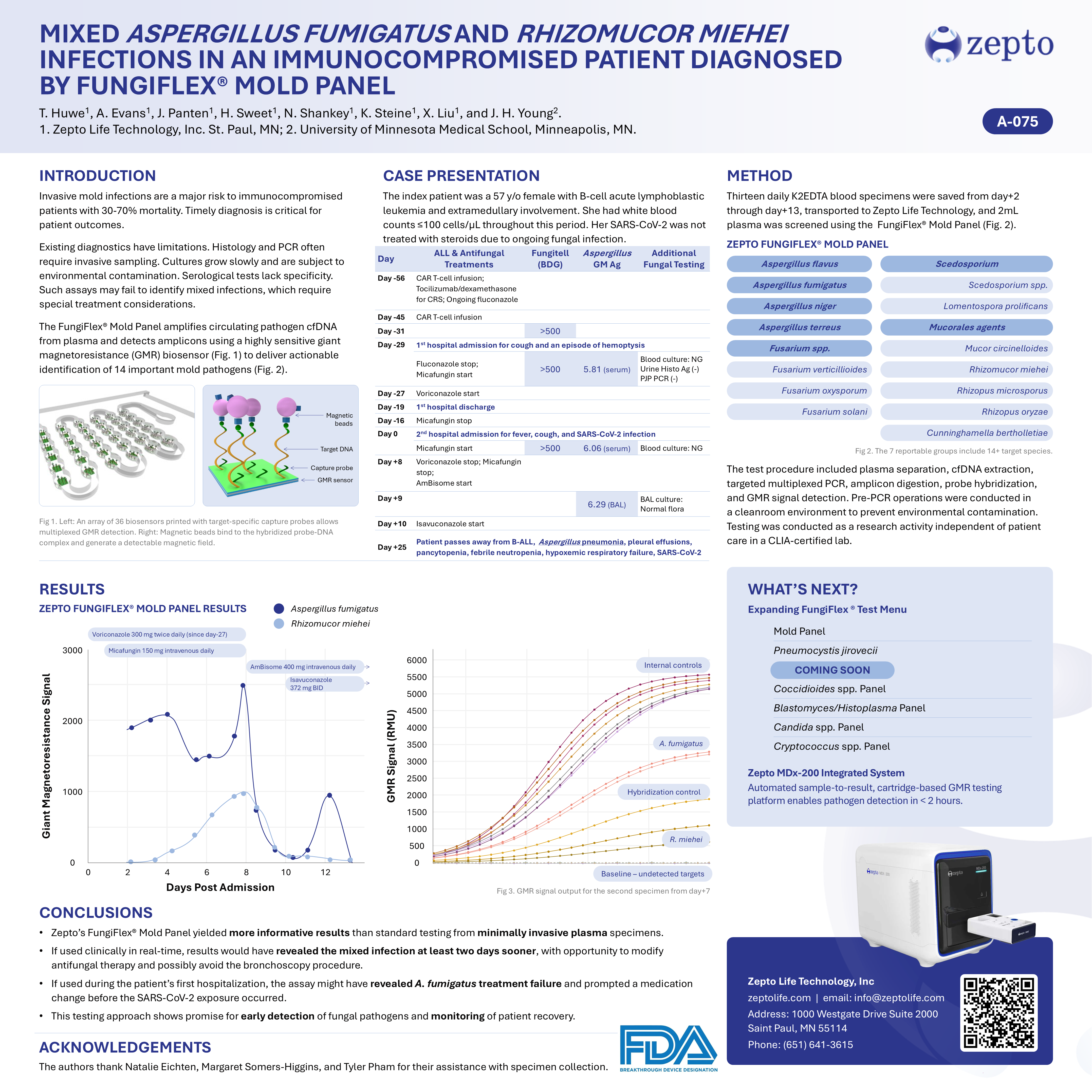
At ADLM 2026, Zepto Life Technology presented a clinical case evaluating the FungiFlex® Mold Panel in a profoundly immunocompromised patient with invasive fungal disease.
The patient was a 57-year-old woman with B-cell acute lymphoblastic leukemia. During two hospitalizations, clinicians used fungal biomarkers, imaging, bronchoscopy, culture, and other testing to investigate a suspected invasive mold infection. Standard testing supported infection with an Aspergillus, but it did not reveal the full picture.
Thirteen blood specimens collected during the patient’s second hospitalization were later analyzed using the FungiFlex® Mold Panel. This testing was conducted retrospectively as a research activity, independently of patient care. The FungiFlex® results were not used to make diagnostic or treatment decisions.
What did FungiFlex® detect?
The research testing identified cell-free DNA from two molds in plasma:
- Aspergillus fumigatus
- Rhizomucor miehei
Together, the findings suggested a mixed invasive mold infection rather than infection with Aspergillus alone.
Based on the retrospective timeline, the authors concluded that real-time FungiFlex® testing could have revealed the second organism and potentially prompted a treatment change at least two days earlier; however, because the test was performed only after the clinical episode, its effect on patient management cannot be determined from this case.
Why does a mixed infection matter?
Different molds may respond differently to antifungal medications. Identifying only one organism may therefore provide an incomplete basis for treatment decisions.
Mixed fungal infections can be particularly difficult to recognize. Cultures may take days to grow and can remain negative. Blood biomarkers such as galactomannan and beta-D-glucan can support suspicion of fungal disease but generally do not identify every organism involved. Obtaining specimens through bronchoscopy or biopsy may provide more direct evidence, but these procedures can be invasive and may not be safe for every patient.
The FungiFlex® Mold Panel is designed to detect fungal cell-free DNA—small fragments of DNA released into the bloodstream—directly from plasma. It uses targeted multiplex PCR and giant magnetoresistance biosensor detection to identify clinically important molds, including Aspergillus, Mucorales, Fusarium, and Scedosporium/Lomentospora.
What can we learn from this case?
This case illustrates an important clinical question:
Could organism-level information from plasma help clinicians recognize complex or mixed fungal infections earlier in the diagnostic journey?
The serial plasma results also suggest that fungal cfDNA testing may have potential applications beyond initial detection, including following changes in pathogen signal over time. Further prospective clinical studies are needed to evaluate those uses.
The poster, "Mixed Aspergillus fumigatus and Rhizomucor miehei Infections in an Immunocompromised Patient Diagnosed by FungiFlex® Mold Panel," was presented by Tiffany Huwe, PhD, and colleagues from Zepto Life Technology in collaboration with the University of Minnesota Medical School.
About Zepto Life Technology
Zepto Life Technology is a molecular diagnostics company offering targeted plasma cell-free DNA (cfDNA) liquid biopsy testing for infectious diseases through its CLIA-certified reference laboratory. The company's growing FungiFlex® test menu provides minimally invasive, organism-level detection of fungal pathogens direct from plasma, while the Zepto MDx Platform is being advanced to bring onsite, sample-to-result liquid biopsy diagnostic capabilities to hospital laboratories.